 |
||||||||||||||
 |
 |
|||||||||||||
|
||||||||||||||
|
Arthur Yap and Robert Yeo: The Lost Interview
By Robert Yeo
Introductory note by Yeow Kai Chai Stepping into the corner apartment on the highest floor of an HDB block, I recall the first time I was here, about two decades ago, when the poet-playwright-librettist-novelist, Robert Yeo, and his family first moved there. Two decades later, the flat remains bright, open and airy, but now its walls overflow with a thousand more books and other literary thingamajigs – not unlike Yeo himself. He remains, at the impressive age of 86, quite the raconteur, with an incredible roll of juicy anecdote — Wong May had choice words about his juvenilia, for one — at the tip of his tongue. It is clear the man has much to share. The reason I'm here is because the stalwart writer has unearthed, among piles of letters, newspaper cut-outs, flyers, what-not's, a few pages containing a hitherto-unseen interview with a compatriot, the iconic poet Arthur Yap, who died in 2006 from laryngeal cancer. Yeo had found it as he was preparing for a panel discussion at an upcoming symposium, Revisiting the Voice(s) of Arthur Yap: 20 Years On, to be held at the National Library in June 2026. Yeo and Yap first met each other at St. Andrew's School, the former three years older than the latter. Yeo had gone on to pursue his pre-university education there from 1957 to 1958 after topping his O-levels cohort at Serangoon English School. Yap was at St. Andrew's from 1950 to 1962 from primary to pre-university. They both attended the University of Singapore and pursued academic careers. In 1971, their paths crossed again as Federal Publications brought out their first poetry collections at the same time: Coming Home Baby by Yeo and Only Lines by Yap. Yeo recalls the launch was held at the old MPH at Stamford Road and drily notes that very few people turned up. He shares the original covers, as well as an advertisement in the 11th April 1971 issue of The Straits Times. The copy hailed them as being "more than only lines, aloof and subtle, sophisticated, sarcastic—yet every now and then the poets give glimpses of undisguised emotions." 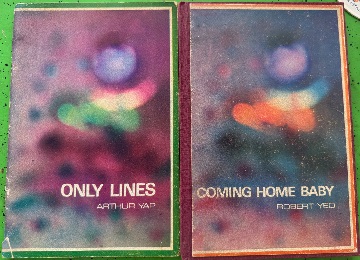 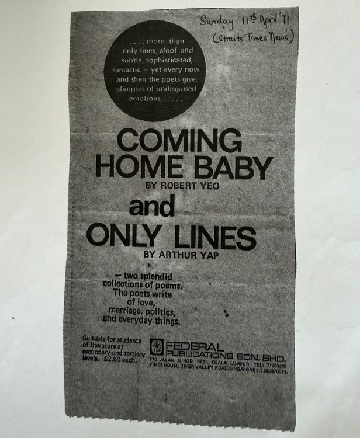 Yeo doesn't remember when and why exactly the interview took place, except that probably happened in the 1990s, and that it must be over print, meaning that he had typed out the questions on several pages of paper, and handed them to Yap. Yap then mulled over the questions and typed out his answers. Yeo reveals that he was at that time trying to unravel how Yap's linguistic background – the latter having attained a Master of Arts in Linguistics and English Language Teaching from the University of Leeds – informed the poetry too. He then shows me a rare copy of Thematic Structure in Poetic Discourse (Copinter, 1987) which he reckons was adapted from Yap's PhD thesis at National University of Singapore. In 1999, Yeo parsed Yap's verse in terms of structural approaches such as textual cohesion, taxis, foregrounding and collocation for an essay "Parts of Speech: A Speculative Note on Arthur Yap's commonplace" which was published in Interlogue: Studies in Singapore Literature, Volume 2: Poetry (Ethos Books). Edited for brevity and house-style, here is the hitherto-unseen interview between Yeo and Yap. Interview Robert Yeo: What made you decide to write? When did you commence to write? Arthur Yap: In school, it was for no other reason than to get something in the school magazine. Another reason was boredom. I started writing when I started secondary school. The subjects I liked took very little of my time and the subjects I disliked took not a bit of my time at all. Hence, I started to paint and write. But it was not until I graduated from the university that I took a more serious interest. I threw away all my juvenilia as a start and am still having to throw away things. RY: Do you see anything paradoxical in using English? AY: When in school, I was fairly proficient in both Mandarin and English. But as the medium of instruction was English, proficiency in Mandarin declined to a sogginess. Also, when I started reading whatever I could get hold of, the books were largely in English. After a while, whatever I read was and is in English. RY: Why did you choose poetry in preference to, say, prose? AY: I have done a little prose writing, but find poetry to be more absorbing. It demands a kind of economy and precision that may not be essential in prose. RY: Were your style and outlook influenced by other writers? AY: I would say no. There are many writers I admire. Before completing secondary school, I had read everything by D. H. Lawrence. I can't say he had any influence on me. I was intrigued by his prose, but found many of his poems clumsy. More currently, I read a lot of Japanese literature in translation. I have read all of Philip Larkin, V. S. Naipaul and a few others. Had I been younger, I would have been moved to do imitations as a form of flattering myself. RY: What poets have influenced you? Have you been influenced by writings other than poetry, such as history, sociology and other subjects? If so, how? AY: I admire Larkin's control. James Dickey considers him a lightweight poet. I don't think Larkin set out to be a sumo wrestler of poetry. Edward Thomas I also admire for his clear use of language. Of Singapore writers, the only person I do look up to is Edwin Thumboo, for two reasons, one of which is not due to poetry. We need a focal point, he supplies it. The other is that many writers have been influenced by him, consciously or otherwise. I don't think any kind of influence is necessarily good or bad per se. When one has found one's own poetic feet or sandals, the influence passes. While it was there, it was formative. I read a lot of other stuff. I enjoy reading what writers, painters, musicians and other people say about their own work. Also, essays, articles on the cinema, autobiographies. RY: Have the work of other writers in Malaysia/Singapore been helpful? AY: Thumboo's Gods Can Die; a very few poems by Wong May. RY: What are the phases through which you have moved in your development as a poet? AY: Since I do not take my early stuff as being of any merit at all, I don't think I can say I go through any marked phases. RY: What are your main themes? Have they changed since the time you started writing? AY: My themes are all exemplary of the human condition. They haven't changed since I started writing. RY: What would you say are the main themes of contemporary poetry in English in Malaysia and Singapore? AY: Personal themes have always a place. These aside, there are what I call "wilful themes"—things to grab attention. There are also the made-in-Singapore themes, and the made-in-other-countries themes. RY: A multiplicity of cultures means a multiplicity of traditions, differing value-systems, attitudes and folkways. What are the traditions which dominate you? How intimately does each enter your thinking and feeling? AY: It is very difficult for me to say what traditions, value-systems, attitudes and folkways have influenced me, though they surely must in some form or other. I don't feel consciously (or self-consciously) Chinese or Singaporean when I write. Yet the intricacy of a multiplicity of customs beckons and I am eclectic in my reactions. RY: Has your background—cultural, social and education—dictate what you write about and how you write? AY: My background influences what and how I write. I don't think I yo-yo between surrogate backgrounds. RY: Which is your main (first) language? If it is not English, how does it act on your writing in English? AY: My mother-tongue is Hokkien. If I am trying to capture conversation in Hokkien or its paraphrase in English, then it has a bearing in what I write. Otherwise, no. RY: What are the problems you have to contend with in finding your own idiom? AY: In not coming to grips with the language fully and in being myself through the language. RY: Would you explain in general terms the procedure whereby your poems get written? How do they start, shape and become completed? AY: I may be moved by an incident, an idea or even a phrase and I stay with it for a while and then write it. It usually takes many drafts before I feel it's any good. RY: What is the dominant tone of your poetry—satiric, comic, reflective, lyrical, tragic? Does it combine any of these? AY: There isn't any dominant tone in my poems. I combine different tones—satiric, comic and reflective. RY: Can you comment on the modes in which your language operates, such as the use of irony, ambiguity, patterns of images, whether it is direct or allusive? AY: I believe I am direct in my writing, though I have been told I am far from being so. I write the way I feel and cannot simply impose on myself. RY: How important is structure in your work? What are the means you adopt to achieve it, such as the formal or inner organisation through imagery and myth? AY: It is very important. Once the subject-matter is there, its shaping is important. Of course, the subject-matter and its structure can run concurrent. There are no particular means I adopt to achieve this structure. As in painting, I react to it intuitively so that there is some initial structuration. The rest is hard work. RY: Poems are at times abandoned. Have you had the experience? Can you recall the reasons in particular instances? Have you gone back to the fragments and got poems out of them? AY: Poems get abandoned all the time. Because we don't abandon ourselves, we get back to the poems and do some laundering on them. They end up with buttons missing and collars torn and get thrown away. Sometimes, fragments like handkerchiefs can be got out of them. With Japanese technology, they can be made into haikus. RY: How has your own writing developed in terms of theme and style? AY: No, except I feel the need to be more concise. RY: Has a writer, a poet especially, any role in society? AY: In Singapore, every poet has a dual role—his professional role and his role as a poet. For myself, the second is a minor one in the sense that as a poet I don't need any image whatever. I don't even need to be 'poetic.' I write because I want to. It isn't even an option. For me, poetry is a means to its own end. RY: Do you think a writer ought to be committed to, such as a belief in social change? AY: A writer can certainly reflect a belief in social change. There is a difference between this and in participating directly in this change. As a human being, participation, in whatever way, is direct. As a poet, it is indirect and it can take whatever form best suited to his ability and orientation. As a writer, I do not love the world enough to want to change it; nor do I in any way dislike it to want out. RY: Do you see the poet as having an influence on society? If he does, in what way? If he does not, why not? AY: A poet has influence insofar as he offers whatever few things he knows, loves, hates, is moved by, is at odds with. It is up to others to take or reject. RY: Do you feel a sense of social, cultural and intellectual alienation—or distance—from society? How has this affected your writing? AY: No. If so, what would I write about, however personal though the observation might be? On the other hand, a certain detachment is necessary. Otherwise, one might as well be writing documentaries. RY: Do you subscribe to Art for Art's sake? AY: No. This is not contradictory that what I have said earlier. What I mean is I don't believe in a hedonistic kind of poetry, and art for art's sake is, I feel, simply that. But I also feel one needs a certain independence from having to be wilfully a purveyor of social messages. RY: In your view, has the role of the writer changed over the years? What is it likely to be in the near future? AY: The role of the writer has moved away from its "coteriness." It is more public now though I hope it will not become too institutional in the future. RY: Living in a multicultural, multilingual society means readers have different backgrounds and expectations. Has this had a bearing on how you write? AY: I can only reach out to those who will want to read my writing and I have neither the ability nor the need to 'widen' so that my writing will reach out to a bigger section of our multicultural and multilingual society. RY: When you write, do have you any audience in mind? AY: In other forms of writing, such as an academic article, I have an audience in mind. In writing poetry, I don't. If I do, then it is probably myself. RY: How would you describe and evaluate the present climate for creative writing? AY: It gets better. But strangely, there doesn't appear to be more "new" writers. More people, though, are writing but fewer people are writing more. RY: Should poetry be written for the masses? If so how would this influence the way you write? AY: The masses may not need poetry. They may not even need Marie Antoinette's cake. Who knows what is wanted? And why should poetry be on the wanted list? RY: What relationship exists or should exist between poetry in English and that of writers in Mandarin, Malay and Tamil? AY: There are translations, but I am not sure if there are any trans-lingual translations. If there aren't, there could be some. RY: What sort of relationship should there be between poetry in English here and the other international literatures? AY: There should be more international exposure of our writings. We read everybody else. Do they read us? RY: Is there a local tradition of English writing? AY: Adversely, there is sometimes an attempt to be obviously "local." More positively, even the younger writers are now surer in their attempts. The "pioneering" period seems to have been lain in the ground and younger writers are to that extent helped on a surer footing. They do not have to carry their iambics like chains. RY: Are there any special problems posed by writing in English? AY: Regionally, we are looked upon as being too English in our writing. This, while it may not be a problem for the individual, may be a problem when it comes to a regional "exchange" of literary efforts. Another problem, more salient in the past than now, is that the English literary tradition was too manifest. I can remember when I first started teaching, students were showing me poems about the death of cypress trees, nightingales and other miscellaneous specimens. Now, they either show me nothing or they show me better stuff.
Revisiting the Voice(s) of Arthur Yap: 20 Years On – A Symposium takes place on 27th June 2026 (Saturday) at Launch Programme Room, Level 7 at National Library from 10am to 5.30pm. Attendance at the symposium is by registration at arthuryap2026@gmail.com. QLRS Vol. 25 No. 2 Apr 2026_____
|
|
|||||||||||||
|
|
|
|
|
|
|
|
|
||||||
|
||||||||||||||
|
|
|||||||||||||
|
||||||||||||||


Copyright © 2001-2026 The Authors
Privacy Policy | Terms of Use |
E-mail